 +974 55641343
  info@orienttech.com.qa
 +974 4451 2997
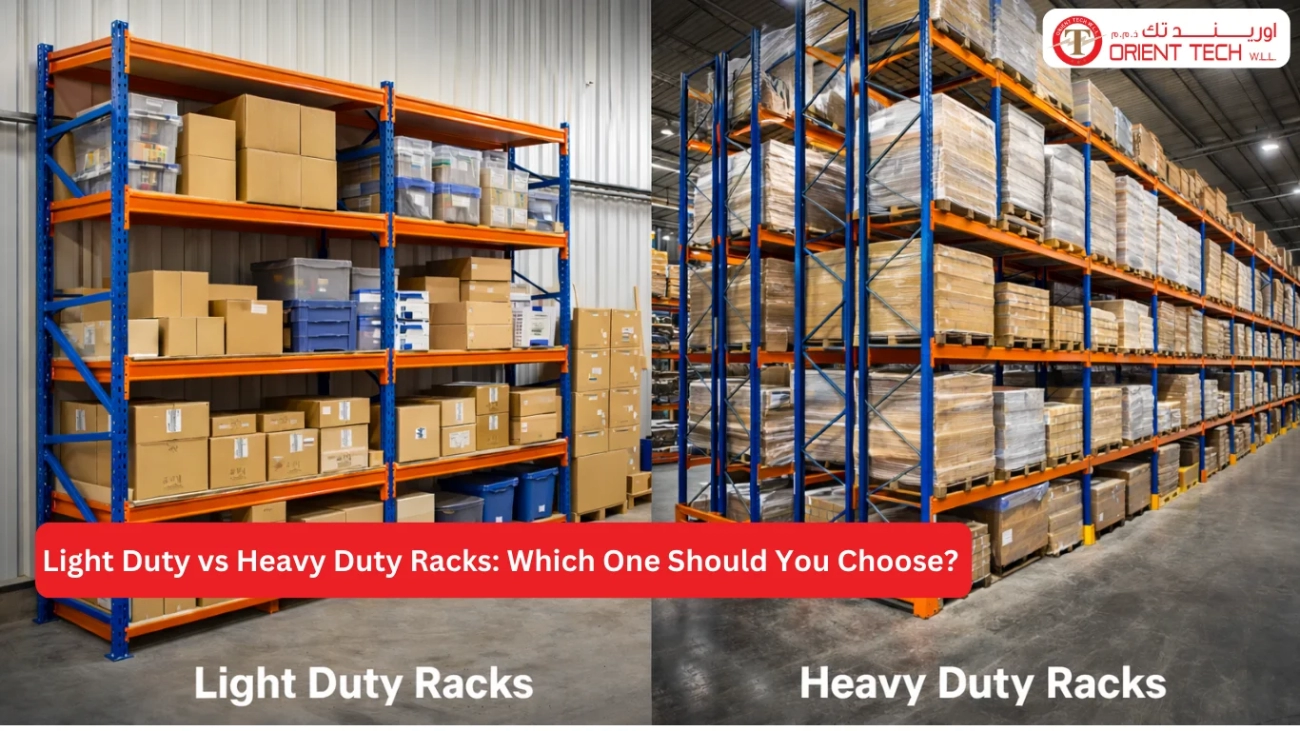
What Are Light Duty Racks?
Key Features of Light Duty Racks:
Lightweight and easy to move: Can be relocated without heavy equipment.
Affordable: Lower cost compared to heavy duty racks.
Ideal for low-volume storage: Suitable for homes, offices, retail stores, and small warehouses.
Easy assembly: Often comes in modular designs that require minimal tools.
Common Uses of Light Duty Racks:
- Office files, books, and stationery
- Small household items or tools
- Packaged consumer goods in retail
- Personal storage in garages or small workshops
Advantages of Light Duty Racks:
- Economical for small-scale storage needs.
- Quick to assemble and reconfigure.
- Compact, saving space in small rooms.
What Are Heavy Duty Racks?
Key Features of Heavy Duty Racks:
High weight capacity: Can handle hundreds or even thousands of kilograms per shelf.
Durable construction: Reinforced steel or metal structures resist bending or damage.
Long-term solution: Built for warehouses, factories, and industrial spaces with heavy storage requirements.
Customizable: Adjustable shelves and modular systems to fit large or irregular items.
Common Uses of Heavy Duty Racks:
- Warehouses storing pallets, boxes, or raw materials
- Factories with machinery or spare parts
- Distribution centers with bulk inventory
- Industrial storage of large tools and equipment
Advantages of Heavy Duty Racks:
- Maximum durability and load-bearing capacity.
- Ideal for large-scale commercial and industrial storage.
- Provides long-term safety and stability for heavy items.
How to Choose Between Light Duty and Heavy Duty Racks
Assess your load weight: If your items are heavy or bulky, heavy duty racks are essential. Light duty racks are sufficient for small, light items.
Consider storage volume: High-volume storage in warehouses requires heavy duty racks for safety and efficiency.
Evaluate your space: Light duty racks are compact and perfect for smaller spaces, while heavy duty racks need more room.
Budget: Light duty racks are more affordable, but for industrial use, investing in heavy duty racks prevents damage and accidents.
Long-term planning: If your storage needs might grow, consider heavy duty racks for scalability and durability.
Benefits of Proper Rack Selection
Safety: Prevents accidents caused by overloaded shelves.
Efficiency: Organizes your space for easy access and workflow.
Durability: Reduces maintenance costs over time.
Cost-effectiveness: Avoids unnecessary expenses on over- or under-engineered solutions.