 +974 55641343
  info@orienttech.com.qa
 +974 4451 2997
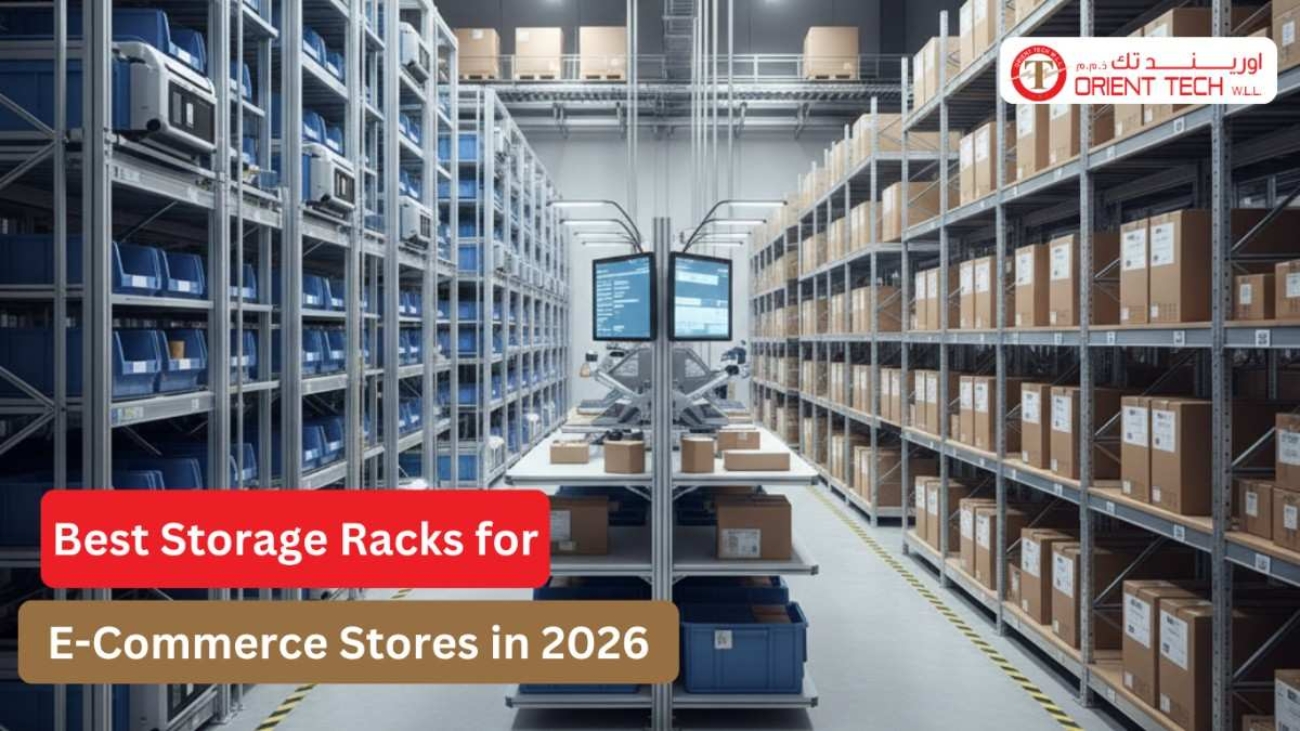
In the fast-moving world of e-commerce, storage and picking efficiency can make or break your fulfilment operations. With increasing customer expectations for rapid delivery, and ever-growing SKU counts, selecting the right storage rack system is more important than ever. This guide offers an informational overview of how to choose storage racks tailored for e-commerce stores in 2026 — including the types of racks, what to look for, and how to maximise storage space.
1. Why Storage Racks Matter for E-Commerce
When you run an e-commerce business (or serve as a third-party fulfilment operation), your warehouse or back-room doesn’t just store goods — it processes orders. As one source states: “The nature of eCommerce fulfilment is evolving quickly … warehouses must now manage an expanding inventory of SKUs in the same or even shrinking footprints.”
- High SKU variability & small-unit picking – Unlike traditional retail warehouses that might deal in pallets, e-commerce often involves smaller units, many SKUs, and rapid turnover.
- Space optimisation – Maximising vertical space, minimising aisle waste, and improving accessibility all translate to cost savings.
- Fulfilment speed & accuracy – The rack system must support fast picking, replenishment, and clear product visibility, reducing errors.
- Scalability and flexibility – As your product mix or business size changes, you need racking that adapts without major rebuilds
2. Key Selection Criteria for 2026
When evaluating storage racks for your e-commerce operation in 2026, consider these critical factors:
a) Load capacity & product variety
You might have light items (small electronics), medium boxes, or bulky items (packaging). Choose racks that can handle different weights and sizes. For example, heavy-duty racks like the Mecalux M7 offer over 1,000 kg per level, and are explicitly used in e-commerce warehouses.
b) Adjustable shelving / modular design
Your product mix may change. Racks with adjustable shelf heights or modular components let you reconfigure without major cost.
c) Vertical utilisation & footprint efficiency
Maximising height (rather than just width) and minimising wasted aisle/aisle space deliver better ROI. Multi-tier shelving, mezzanine systems or high-density configurations are beneficial.
d) Picking, replenishment & flow-through design
E-commerce picking often involves rapid retrieval of individual units. Storage systems that streamline picking (carton flow, gravity feed, well laid out aisles) can improve throughput.
e) Safety, durability & maintenance
Rack damage or collapse causes downtime, injuries and cost. Choose systems built with safety in mind and designed for industrial use.
f) Scalability and future-proofing
What works today may not suffice in a year. Choose racking systems that can grow with your business.
3. Types of Storage Racks for E-Commerce Fulfilment
Here are some of the key rack types frequently used in e-commerce / warehouse operations:
• Selective Pallet Racking
The classic pallet rack: direct access to each pallet, good for reserve stock storage, pallet goods.
• Long-Span / Industrial Shelving
Ideal for cartons, boxes, or mixed SKUs. Flexible, adjustable shelves.
• Multi-Tier / Mezzanine Shelving
Adds levels/floors to existing space to increase footprint without expanding the building. Good for fast-moving SKUs.
• Carton/Flow Racks or Gravity-Feed Systems
Good for high-velocity SKUs: items loaded at the back, picked at the front; FIFO (first-in first-out) efficiency.
• High-Density / Automated Systems
When space is at a premium and picking speed is critical, high-density racks or AS/RS (automated) systems help.
4. Implementation Tips & Best Practices
- Start with slotting & SKU strategy – Know which SKUs are high-velocity and place them in easy-access zones.
- Design for picking flow – Minimise picker travel, keep pick faces at ergonomic height, ensure visibility.
- Label and organise – Clear labels, zone identification, barcode/RFID support help accuracy.
- Use vertical space wisely – Use grate or mesh decking, use mezzanines, consider double-deep or multi-tier layouts if viable.
- Regular maintenance & safety checks – Inspect uprights, beams, footplates; ensure no overloading.
- Plan for growth and change – Leave flexibility in your layout: future product lines, seasonal peaks, SKU proliferation.
- Integrate with adjacent processes – Receiving → storage → picking → packing → shipping. Rack design should support the full flow.
- Utilise metrics – Monitor pick times, errors, space utilisation, inventory velocity, and adjust accordingly.
5. Common Mistakes to Avoid
- Installing fixed shelving without regard for future changes in product size or mix.
- Over-relying on horizontal expansion rather than vertical space.
- Ignoring aisle widths and picker travel time (which slow down fulfilment).
- Under-estimating maintenance and damage risk to racking structures.
- Choosing cheap racks without proper load capacity, leading to safety & compliance risks.
- Not aligning rack selection with picking/replenishment workflow — leading to inefficiencies.
Conclusion
Choosing the best storage racks for your e-commerce store in 2026 means more than just purchasing steel shelves. It’s about aligning your storage infrastructure with your picking, replenishment, and inventory flow — ensuring flexibility, space optimisation, and operational speed. By partnering with Orient Tech WLL, you can implement load-appropriate, adjustable, and scalable storage systems that seamlessly integrate into your fulfilment process. With Orient Tech WLL’s expertise, your business will be well-equipped to meet growing customer expectations and stay competitive in the evolving e-commerce landscape.